


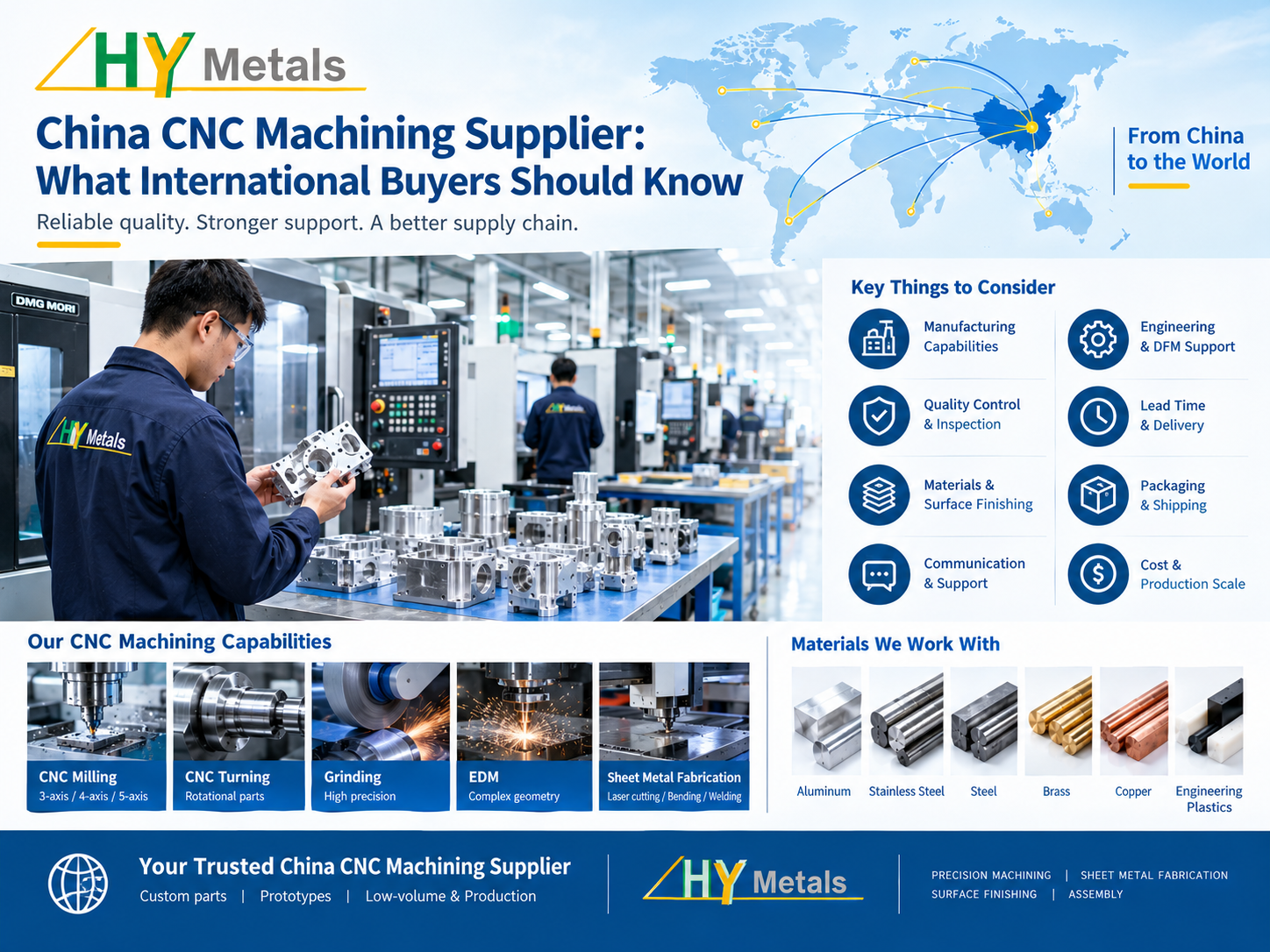
China CNC Machining Supplier: What International Buyers Should Know

For companies in the US and Europe, sourcing CNC machined parts from China can provide access to extensive manufacturing capabilities, competitive production costs, and flexible capacity.
However, choosing a China CNC machining supplier should involve more than comparing quotations.
International buyers need to evaluate manufacturing capabilities, engineering support, quality control, material management, communication, lead time, packaging, and shipping.
A supplier that can produce a low-cost prototype is not necessarily the right partner for a demanding production program.
The real objective is to find a manufacturing partner that can consistently produce the required parts to the required specification.
1. Why Do Companies Source CNC Machining From China?
China has a large and diverse manufacturing ecosystem supporting industries such as:
- Industrial automation
- Robotics
- Electronics
- Automotive
- Aerospace
- Medical equipment
- Consumer products
- Telecommunications
- Machinery
This manufacturing environment gives international buyers access to a broad range of CNC machining processes, materials, surface treatments, and production capabilities.
For buyers, the potential advantages of CNC machining in China can include:
- Broad manufacturing capabilities
- Competitive production costs
- Large material availability
- Flexible prototype and production capacity
- Experienced engineering teams
- Multiple machining processes
- Extensive surface finishing options
However, these advantages depend heavily on the individual supplier.
China is a manufacturing location, not a guarantee of quality.
The supplier’s actual equipment, engineering experience, quality system, and production management are what determine the result.
2. Look Beyond the Trading Company
One of the first questions an international buyer should ask is:
Are you dealing directly with the manufacturer?
There are many different types of companies involved in international manufacturing:
- Manufacturing factories
- Trading companies
- Sourcing companies
- Manufacturing service providers
- Hybrid companies
A trading company may be able to provide competitive pricing, but buyers should understand where their parts will actually be manufactured.
A direct manufacturing partner can potentially provide clearer communication between:
Customer → Engineer → Production → Quality Control
This can be especially important for custom CNC machined parts with complex drawings, tight tolerances, or special inspection requirements.
When evaluating a China CNC manufacturer, ask:
- Where are the parts manufactured?
- What processes are performed in-house?
- What CNC equipment is available?
- Who handles engineering questions?
- Where does quality inspection take place?
- Which processes are outsourced?
3. Check the Actual CNC Machining Capabilities
A supplier’s website may say “CNC machining,” but that description alone does not tell you whether the factory can manufacture your particular part.
International buyers should look at the actual process capabilities.
These may include:
CNC Milling
Suitable for:
- Housings
- Brackets
- Plates
- Fixtures
- Complex 3D components
- Multi-surface parts
CNC Turning
Suitable for:
- Shafts
- Pins
- Bushings
- Sleeves
- Spacers
- Cylindrical components
Multi-Axis Machining
3-axis, 4-axis, and 5-axis machining can be useful for complex geometry and reducing the number of setups.
Other Processes
Depending on the project, a supplier may also need:
- Grinding
- EDM
- Wire EDM
- Deep-hole drilling
- Threading
- Surface finishing
- Inspection
HY Metals currently describes its CNC operation as having four CNC manufacturing facilities and more than 150 multi-axis CNC machines, including more than 20 full 5-axis machines. Its capabilities include CNC milling, turning, grinding, EDM, and other precision processes.
This type of manufacturing depth can be important when a project contains multiple machining requirements.
4. Engineering Support Matters
A good CNC machined parts supplier should do more than simply manufacture the CAD file.
Before production, an experienced engineering team should be able to identify potential manufacturing issues.
For example:
- Thin walls
- Deep pockets
- Difficult internal corners
- Unnecessary tight tolerances
- Difficult tool access
- Poor datum structures
- Difficult-to-machine materials
- Complex setups
This is commonly known as Design for Manufacturability (DFM).
DFM feedback can help identify problems before production rather than after the first parts have already been machined.
For international buyers, this can be particularly valuable because engineering communication is often happening remotely.
5. Quality Control Should Be Clearly Defined
Quality control is one of the most important factors when selecting a China precision machining supplier.
Do not simply ask:
“Do you have quality control?”
Ask what the supplier actually does.
A professional CNC manufacturing process may include:
Incoming Material Inspection
Verify:
- Material grade
- Dimensions
- Material certificates
- Traceability where required
First Article Inspection
The first completed parts can be measured against the engineering drawing to verify:
- Critical dimensions
- General dimensions
- Tolerances
- Threads
- Geometric requirements
- Surface finish
In-Process Inspection
Important dimensions can be checked during machining rather than waiting until the end.
Final Inspection
Finished parts can undergo dimensional and visual inspection before shipment.
HY Metals states that its manufacturing system is ISO 9001:2015 certified and supports full-dimensional FAI inspection. The company also describes inspection using equipment such as CMM and optical measurement systems.
6. Material Verification Is Important
When sourcing custom CNC parts from China, material selection should be clearly documented.
Common CNC materials include:
- Aluminum
- Stainless steel
- Carbon steel
- Tool steel
- Brass
- Copper
- Titanium
- Engineering plastics
For critical components, buyers may require material certification.
This is particularly important when the material specification affects:
- Strength
- Corrosion resistance
- Temperature performance
- Electrical conductivity
- Weight
- Dimensional stability
A professional supplier should be able to identify the material used for production and provide appropriate documentation when required.
7. Surface Finishing Should Be Part of the RFQ
CNC machining is often only one step in the manufacturing process.
Your drawing may also require:
- Anodizing
- Hard anodizing
- Powder coating
- Electroless nickel plating
- Zinc plating
- Passivation
- Polishing
- Sandblasting
- Brushing
- Painting
- Laser marking
The surface finish should be clearly specified before quotation.
This is important because finishing can affect both appearance and dimensions.
For precision CNC parts, a coating that adds thickness to a critical feature may affect the final fit.
A capable supplier should review these requirements during the quotation and DFM stage.
8. Communication Is Critical for International Buyers
When working with a supplier thousands of miles away, communication becomes part of the manufacturing process.
A good supplier should be able to communicate clearly about:
- Drawing questions
- Material
- Tolerances
- Surface finish
- Production schedule
- Inspection results
- Packaging
- Shipping
For international projects, clear communication can prevent misunderstandings before they become production problems.
It is also useful to have a dedicated engineering or project contact who understands technical drawings rather than relying only on sales communication.
9. Ask About Lead Time Realistically
When comparing China CNC machining suppliers, do not look only at the quoted number of days.
Ask what the lead time actually includes.
For example:
Material purchasing → Programming → Setup → CNC machining → Inspection → Surface finishing → Final inspection → Packaging → Shipping
A supplier may quote five machining days, but the complete delivery time can be longer once material preparation, finishing, inspection, and international shipping are included.
HY Metals states that RFQs can typically receive a response within 1–8 hours, depending on the project and requirements.
For prototypes and urgent projects, fast engineering communication can make a significant difference.
10. Consider the Production Quantity
The right supplier should be able to support your current quantity as well as your potential future requirements.
Different projects may require:
- 1 prototype
- 5–20 prototypes
- 50–500 low-volume parts
- Thousands of production parts
A supplier experienced only in mass production may not provide the same flexibility for prototype development.
Similarly, a small prototype workshop may not have enough capacity for production orders.
Before placing an order, ask:
Can this supplier support the entire product lifecycle?
From prototype to low-volume production and eventually larger production runs, continuity can simplify supplier management.
11. Packaging and Shipping Matter More Than Many Buyers Expect
A perfectly machined part can still arrive damaged if it is poorly packaged.
International buyers should consider:
- Individual protection
- Anti-rust protection
- Surface protection
- Separation between parts
- Custom foam or trays
- Carton strength
- Palletization
- Moisture protection
For machined aluminum or stainless steel parts with cosmetic surfaces, preventing scratches during transportation can be particularly important.
Shipping documentation should also be prepared according to the buyer’s requirements.
12. How to Compare CNC Machining Quotes From China
The lowest quotation is not always the lowest total cost.
When comparing suppliers, look at:
| Factor | What to Check |
|---|---|
| Part price | Is the quotation complete? |
| Material | Correct grade and specification? |
| Tolerance | Can the supplier meet the critical dimensions? |
| Finish | Included or quoted separately? |
| Inspection | What inspection is included? |
| Tooling | Any additional tooling charges? |
| Packaging | Standard or customized? |
| Lead time | Complete production lead time? |
| Shipping | Included or separate? |
| Engineering | Is DFM support available? |
A quotation should be compared on the total delivered requirement, not simply the unit price.
13. Questions to Ask a China CNC Machining Supplier
Before placing your first order, consider asking:
- Where will my parts be manufactured?
- Which CNC processes are performed in-house?
- Can you review my drawings for DFM?
- What materials can you machine?
- How do you control tight tolerances?
- What inspection equipment do you use?
- Can you provide FAI or dimensional inspection reports?
- Can you provide material certificates?
- What surface finishes can you provide?
- What is the realistic production lead time?
- How will the parts be packaged?
- Can you support future production volumes?
The answers to these questions can tell you much more than a simple price comparison.
14. Why HY Metals Supports International CNC Buyers
HY Metals was founded in 2010 and specializes in sheet metal fabrication and precision machining.
Its current CNC capabilities include four CNC manufacturing facilities, more than 150 multi-axis CNC machines, and more than 20 full 5-axis machines. The company supports CNC milling, CNC turning, grinding, EDM, and precision machining for a broad range of materials.
HY Metals also combines CNC machining with other manufacturing capabilities such as sheet metal fabrication, welding, assembly, and surface finishing.
This allows international customers to source different custom components through one manufacturing partner instead of coordinating multiple suppliers.
The company also provides engineering and DFM support during the quotation process, helping customers review material selection, geometry, tolerance, and finishing requirements before production.
Conclusion
Choosing a China CNC machining supplier is not simply about finding a low quotation.
International buyers should evaluate the complete manufacturing capability:
Engineering + CNC Equipment + Materials + Quality Control + Inspection + Finishing + Communication + Lead Time + Shipping
A reliable supplier should be able to understand your drawings, identify manufacturing risks, produce the parts consistently, inspect the finished components, and communicate clearly throughout the project.
For companies sourcing CNC machined parts from China, the best long-term supplier relationship is built around consistent quality, engineering support, transparent communication, and reliable production.
Looking for a China CNC machining supplier?
HY Metals provides custom CNC milling, CNC turning, multi-axis machining, precision machining, sheet metal fabrication, surface finishing, and inspection for prototypes, low-volume production, and production parts.
Send your CAD files and drawings to HY Metals for a manufacturing review and quotation.
-
HY Metals:Your One Stop Shop for High Quality C...
-
Materials and finishes for sheet metal parts an...
-

How to Choose the Right Material for CNC Machin...
-

10-Day Turnaround on AL6063 CNC Machined Heat S...
-

Custom precision CNC machined Titanium parts wi...
-
Customized CNC machined aluminum parts with san...