How to Choose the Right Material for CNC Machined Parts

Choosing the right material is one of the most important decisions when designing CNC machined parts.
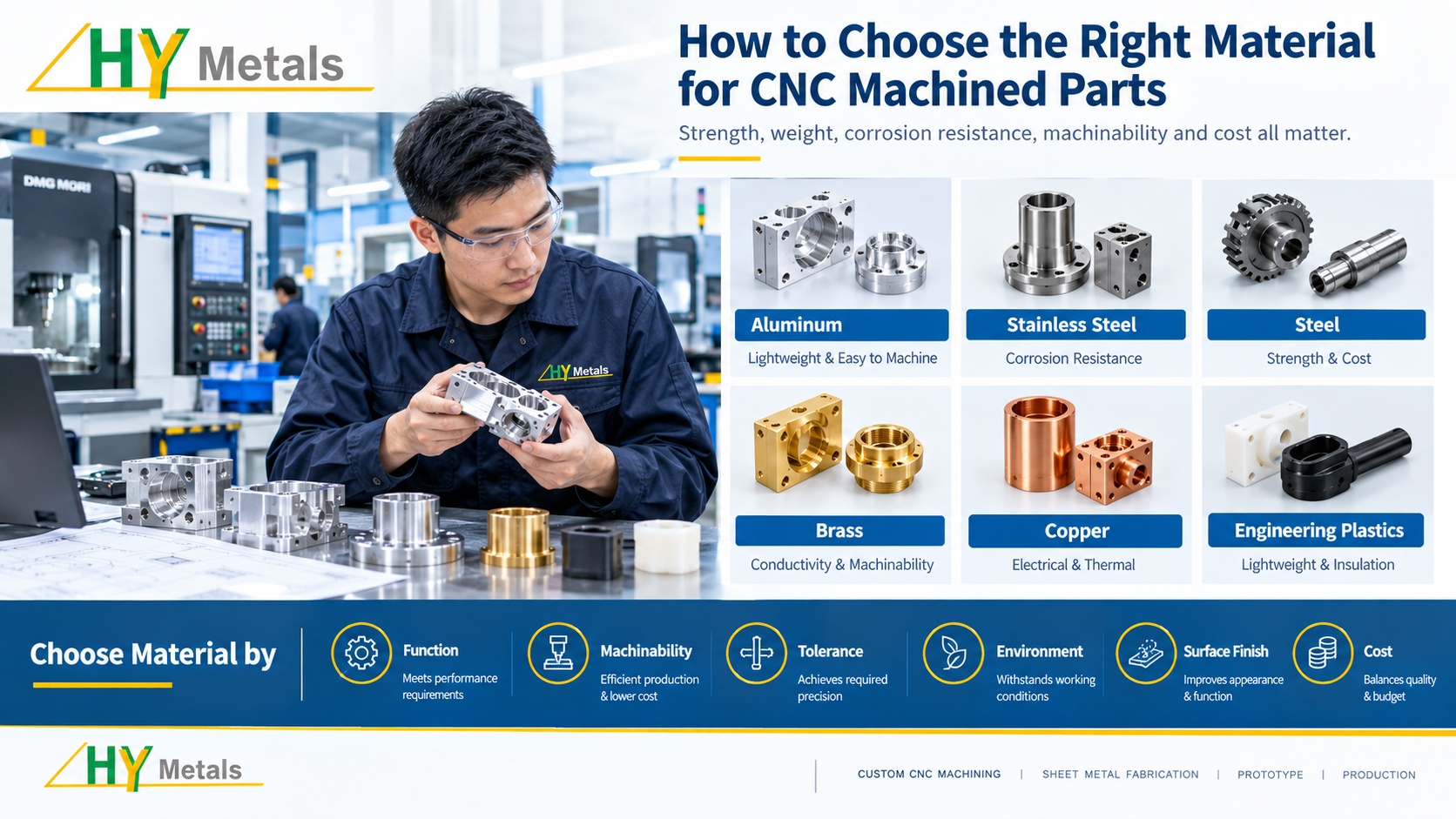
The material affects almost every aspect of a component, including strength, weight, corrosion resistance, machinability, dimensional stability, surface finish, cost, and service life.
For this reason, selecting a material should not simply be a question of choosing the cheapest or strongest option.
The best CNC machining material is the one that provides the required performance while remaining practical to machine and cost-effective to manufacture.
HY Metals provides custom CNC machining for a wide range of metals and engineering plastics, including aluminum, stainless steel, steel, brass, copper, and machinable plastics.
1. What Should You Consider When Selecting CNC Machining Materials?
Before selecting a material for a precision machined part, engineers should consider several factors.
Mechanical requirements
Ask:
- How strong does the part need to be?
- Does it need high hardness?
- Will it experience vibration or impact?
- Does it need to resist wear?
- Is the part structural or mainly cosmetic?
Weight
For aerospace, robotics, automation, and portable equipment, weight can be an important design factor. Aluminum is often attractive because it provides a useful combination of low weight, machinability, and corrosion resistance.
Corrosion resistance
Parts used outdoors, in medical equipment, industrial environments, or near moisture may require good corrosion resistance. Stainless steel and some aluminum alloys can be suitable choices depending on the application.
Temperature and environment
The operating environment can also determine the material. Consider: Temperature, Humidity, Chemicals, UV exposure, Electrical requirements, Heat transfer, Wear conditions.
Machinability
Two materials with similar mechanical properties may behave very differently during CNC machining. Material hardness, cutting behavior, thermal characteristics, and tool wear all affect production efficiency. Therefore, material selection and manufacturing process selection should be considered together.
2. Aluminum CNC Machining
Aluminum is one of the most commonly used materials for CNC machined parts. Popular alloys include 6061-T6, 6061-T651, 6063, 7075, 6082, 5052 for sheet metal applications. HY Metals lists aluminum alloys including 6061, 6063, 7075, 1060, 1100, and 6082 among its supported materials.
Why choose aluminum?
- Low weight
- Good machinability
- Good corrosion resistance
- Good strength-to-weight ratio
- Excellent anodizing capability
- Attractive appearance
3. Stainless Steel CNC Machining
Stainless steel is a strong choice when corrosion resistance and durability are important. Common CNC machining grades include SUS303, SUS304, SUS316, SUS316L. HY Metals supports stainless steel materials including SUS303, SUS304, SUS304L, SUS316, and SUS316L.
Advantages of stainless steel:
- High corrosion resistance
- Good strength
- Good durability
- Excellent appearance
- Good temperature resistance
4. Steel CNC Machining
Steel remains an important material for CNC machined components where strength, hardness, wear resistance, or cost are major considerations. Different steel grades are available for different applications including Mild steel, Carbon steel, Tool steel, Alloy steel, Free-machining steel.
5. Brass CNC Machining
Brass is an excellent choice when machinability, appearance, and electrical or mechanical performance are important. It is commonly used for Bushings, Fittings, Connectors, Electrical components, Valves, Decorative mechanical components.
6. Copper CNC Machining
Copper is particularly useful when electrical or thermal conductivity is important. Typical applications include Electrical components, Conductive parts, Heat-transfer components, Connectors, Busbars, Electronic components.
7. Engineering Plastics for CNC Machining
CNC machining is not limited to metals. Common CNC machinable plastics include POM / Delrin, PEEK, PPSU, PC, Nylon, PTFE, PEI, PMMA, PVC. HY Metals lists a broad range of machinable engineering plastics, including POM, PEEK, PPSU, PSU, PEI, PTFE, PMMA, PVC, and others.
8. Material Choice Can Affect CNC Machining Cost
Material price is only one part of the total manufacturing cost. The actual CNC machining cost can be influenced by: Raw material price, Material hardness, Machining time, Tool wear, Cutting speed, Number of setups, Scrap risk, Surface finishing, Inspection requirements.
9. Material and CNC Machining Tolerance
Material selection can also affect dimensional accuracy. Different materials respond differently to Cutting heat, Thermal expansion, Internal stress, Tool pressure, Workholding, Machining forces.
10. Surface Finish Should Be Considered Before Production
Material selection and surface finishing are often connected. HY Metals provides a range of surface treatments for both sheet metal and CNC machined parts. For precision CNC parts, however, coating thickness must be considered because a surface treatment can affect critical dimensions.
11. A Simple CNC Material Selection Guide
| Requirement | Materials to Consider |
|---|---|
| Low weight | Aluminum, engineering plastics |
| High strength | Steel, stainless steel, 7075 aluminum |
| Corrosion resistance | Stainless steel, aluminum |
| Easy machining | Aluminum, brass, POM |
12. How to Choose the Best Material for Your CNC Part
Before releasing a drawing for production, ask these questions: What does the part actually do? What loads will it experience? How important is weight? What environment will it operate in? What tolerance is required? Does the part require surface finishing? What production quantity is required? Can the material be machined efficiently?
13. How HY Metals Helps With CNC Material Selection
HY Metals provides custom CNC machining for prototypes, low-volume production, and production components. Its broad manufacturing capability allows engineers to evaluate material selection together with the actual machining process, focusing on: Material → Geometry → Tolerance → Machining Process → Surface Finish → Inspection.
Conclusion
Choosing the right CNC machining material is about more than strength or price. The best material depends on the complete application: Function + Strength + Weight + Environment + Machinability + Tolerance + Surface Finish + Cost. For precision CNC machined parts, making the material decision early can help improve quality, control cost, and reduce manufacturing risk.
Have a CNC machining project? Send your drawings and material requirements to HY Metals for engineering review, DFM feedback, and a quotation. inquiry@hymetalproducts.com;susanx@hymetalproducts.com