


When ordering custom CNC machined parts, one of the most important manufacturing decisions is choosing the right machining process.
Two of the most common CNC processes are CNC milling and CNC turning.
Both processes use computer-controlled machines and precision cutting tools, but they work in fundamentally different ways.
CNC milling is generally used when the cutting tool moves around a stationary workpiece.
CNC turning is generally used when the workpiece rotates while a cutting tool removes material.
Understanding the difference can help engineers select the right manufacturing process, improve part design, and avoid unnecessary production costs.
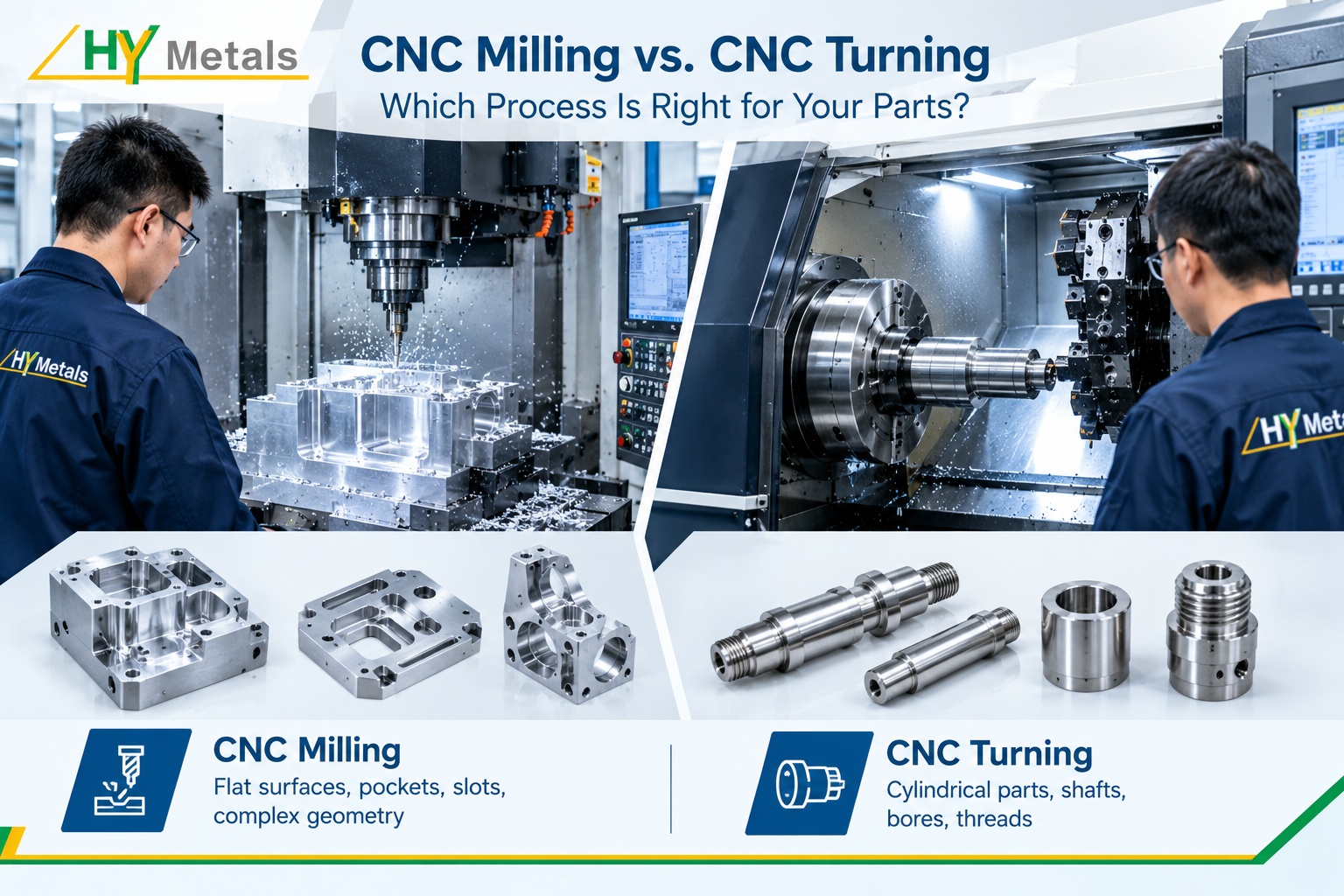
CNC milling is a subtractive manufacturing process in which a rotating cutting tool removes material from a workpiece.
The workpiece is usually secured to a fixture or machine table while the cutting tool moves along programmed axes.
Common CNC milling machines include:
- 3-axis CNC machines
- 4-axis CNC machines
- 5-axis CNC machines
- Multi-axis machining centers
CNC milling is particularly suitable for parts with:
Typical CNC milling applications include:
- Machine housings
- Brackets
- Aluminum blocks
- Fixtures
- Robotics components
- Automation components
- Medical equipment components
HY Metals’ CNC machining capability includes 3-axis, 4-axis and 5-axis milling, as well as other precision machining processes.
CNC turning works differently.
In CNC turning, the workpiece rotates while a cutting tool moves against the rotating material.
This makes CNC turning particularly effective for rotational components.
Typical CNC turned parts include:
CNC turning is often performed on a CNC lathe or CNC turning center.
Modern turning centers can also include live tooling, allowing milling and drilling operations to be performed on the same machine.
HY Metals uses CNC turning for a wide range of cylindrical components, including shafts, bearings, bushes, pins, end caps, tubes, standoffs, screws and nuts.
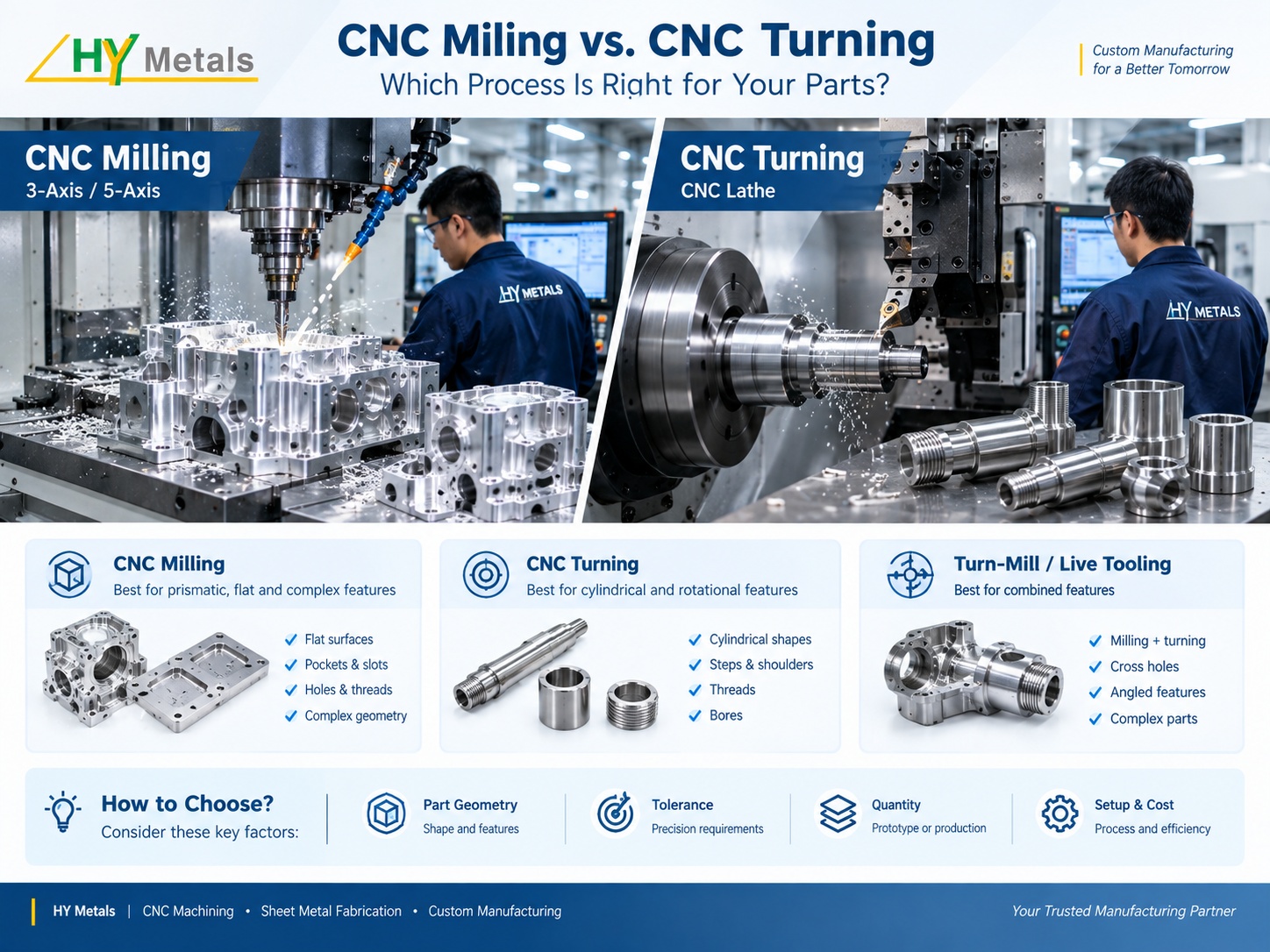
The easiest way to understand the difference is to look at what moves.
|
Feature |
CNC Milling |
CNC Turning |
|---|---|---|
|
Main movement |
Cutting tool moves |
Workpiece rotates |
|
Typical machine |
CNC machining center |
CNC lathe / turning center |
|
Best for |
Prismatic and complex parts |
Cylindrical and rotational parts |
|
Typical features |
Pockets, slots, holes |
Shafts, bores, threads |
|
Typical materials |
Metals and plastics |
Metals and plastics |
|
Multi-axis options |
3-axis, 4-axis, 5-axis |
Turning + live tooling |
|
Common parts |
Housings, brackets, plates |
Shafts, pins, bushings |
The choice should ultimately be based on the geometry and functional requirements of the component.
CNC milling is generally the better choice when the part has a relatively complex or non-rotational geometry.
For example, consider an aluminum housing with:
- Four mounting holes
- Multiple pockets
- Internal cavities
- Flat mounting surfaces
- Side holes
- Threaded holes
- Curved external surfaces
This type of component is usually more suitable for CNC milling.
For more complex geometry, 4-axis or 5-axis machining can reduce the number of setups required.
CNC turning is generally the better choice for parts dominated by cylindrical geometry.
Examples include:
Shafts
Precision shafts often require controlled diameters, shoulders, grooves and threads.
Bushings
Bushings typically require accurate internal and external diameters.
Pins
Pins are usually rotational components that can be efficiently produced from bar stock.
Spacers
Cylindrical spacers are another common turning application.
Threaded Components
CNC turning can efficiently produce external and internal threads.
For high-volume cylindrical parts, CNC turning can also provide excellent production efficiency.
Some components do not fit neatly into either category.
For example, a component may have:
- A cylindrical main body
- Cross holes
- Milled flats
- Slots
- Threads
- Radial features
A turn-mill machine with live tooling can combine turning and milling operations.
This can reduce the number of setups and eliminate some secondary operations.
The result can be:
- Better feature alignment
- Reduced handling
- Shorter production time
- More consistent quality
For complex rotational components, turn-mill machining can be an efficient solution.
Not all CNC milling requires 5-axis machining.
3-Axis CNC Milling
3-axis machining is suitable for many conventional components.
Typical parts include:
- Plates
- Brackets
- Simple housings
- Blocks
- Fixtures
If all important features can be reached from a small number of orientations, 3-axis machining may be the most economical option.
5-Axis CNC Machining
5-axis machining becomes more useful when a component contains:
- Multiple angled surfaces
- Complex contours
- Deep cavities
- Difficult-to-access features
- Multiple faces requiring precise relationships
Reducing setups can help improve positional consistency.
HY Metals currently lists multi-axis CNC capabilities, including 5-axis machining, for complex precision components.
It is tempting to ask whether CNC milling or CNC turning is more accurate.
The better answer is:
Neither process is automatically more accurate.
Accuracy depends on:
For a cylindrical shaft, CNC turning may provide excellent dimensional control.
For a complex aluminum housing, CNC milling may be the appropriate process for controlling multiple features.
The right question is not:
Which machine is more accurate?
The better question is:
Which process provides the best control of the features that matter on this part?
Cost also depends heavily on the part.
For a simple cylindrical component, CNC turning may be highly efficient because the part can be produced directly from bar stock.
For a complex housing, CNC milling may be more appropriate even if the machining cycle is longer.
Cost is influenced by:
- Material usage
- Cycle time
- Number of setups
- Tooling
- Machine type
- Quantity
- Part complexity
- Inspection requirements
- Surface finishing
For production quantities, process optimization can significantly reduce unit cost.
Both processes are excellent for prototypes.
CNC machining is particularly useful for prototypes because it allows engineers to test real materials and real mechanical features.
For example:
Prototype housing → CNC milling
Prototype shaft → CNC turning
Prototype rotational housing with milled features → turn-mill machining
Using the same manufacturing technology for prototypes and production can also make the transition to production easier.
HY Metals specializes in prototype and low-volume CNC machining and offers both milling and turning capabilities.
Material also influences process selection.
Aluminum is commonly machined using both milling and turning.
Stainless steel can also be processed using either method, but cutting conditions and tooling must be carefully selected.
Brass is often highly machinable and is widely used for turned components.
Engineering plastics can be milled or turned depending on the geometry.
HY Metals lists aluminum, stainless steel, steel, brass, copper and machinable engineering plastics among its CNC machining materials.
After machining, many parts require additional finishing.
Common finishes include:
For aluminum CNC machined parts, anodizing is a common choice.
For stainless steel components, passivation may be appropriate for certain applications.
For steel and copper components, electroplating can be used depending on the functional requirements.
HY Metals provides a range of surface finishing options for CNC machined parts.
The choice does not always have to be milling or turning.
For many products, both processes are used together.
For example, a machine assembly may contain:
- CNC milled housing
- CNC turned shaft
- CNC turned bushings
- CNC milled brackets
- Sheet metal enclosure
This is particularly important for companies sourcing complete assemblies.
A supplier with both CNC machining and sheet metal fabrication capabilities can simplify the manufacturing process and communication.
HY Metals operates CNC machining alongside sheet metal fabrication and other custom manufacturing services, providing a one-stop manufacturing model for custom metal and plastic parts.
When reviewing a new component, ask these questions:
1. Is the part mainly cylindrical?
If yes, CNC turning may be the best starting point.
2. Does the part contain many flat surfaces, pockets or irregular features?
CNC milling may be more appropriate.
3. Does the part combine rotational and milled features?
Consider turn-mill machining.
4. Does the part require multiple angled surfaces?
Consider 4-axis or 5-axis CNC machining.
5. What tolerances are required?
The machining process should be selected based on the critical features and tolerances.
6. What is the production quantity?
The optimal process can change depending on whether you need:
- 1 prototype
- 10 prototypes
- 100 production parts
- 1,000+ production parts
CNC milling and CNC turning are complementary manufacturing processes rather than competing technologies.
CNC milling is generally ideal for prismatic, flat, pocketed and complex geometries.
CNC turning is generally ideal for cylindrical and rotational components.
For more complicated parts, turn-mill and multi-axis machining can combine different capabilities into one manufacturing process.
The best CNC machining supplier should therefore be able to evaluate your drawings and recommend the most appropriate process based on geometry, material, tolerance, quantity and cost.
HY Metals provides CNC milling, CNC turning, multi-axis machining, grinding and EDM, together with sheet metal fabrication and other custom manufacturing capabilities.
Have a CNC machining project? Send your drawings and requirements to HY Metals for a manufacturing review and quotation.
Post time: Sep-12-2026