


Why CNC Prototyping Before Mass Production Can Save Time and Cost
For manufacturers developing custom mechanical components, moving directly from an engineering drawing to mass production may seem like the fastest way to meet a delivery schedule.
However, skipping prototype testing can create unexpected manufacturing problems, expensive design changes, and serious production delays.
CNC prototype machining is not simply about making a few sample parts. It is an important stage for validating the complete manufacturing solution, including machining processes, material properties, heat treatment, surface finishing, dimensional tolerances, and actual product performance.
At HY Metals, we have extensive experience in custom CNC machining and prototype manufacturing. We understand that identifying potential problems before mass production can help customers reduce risk, control costs, and bring products to market more efficiently.
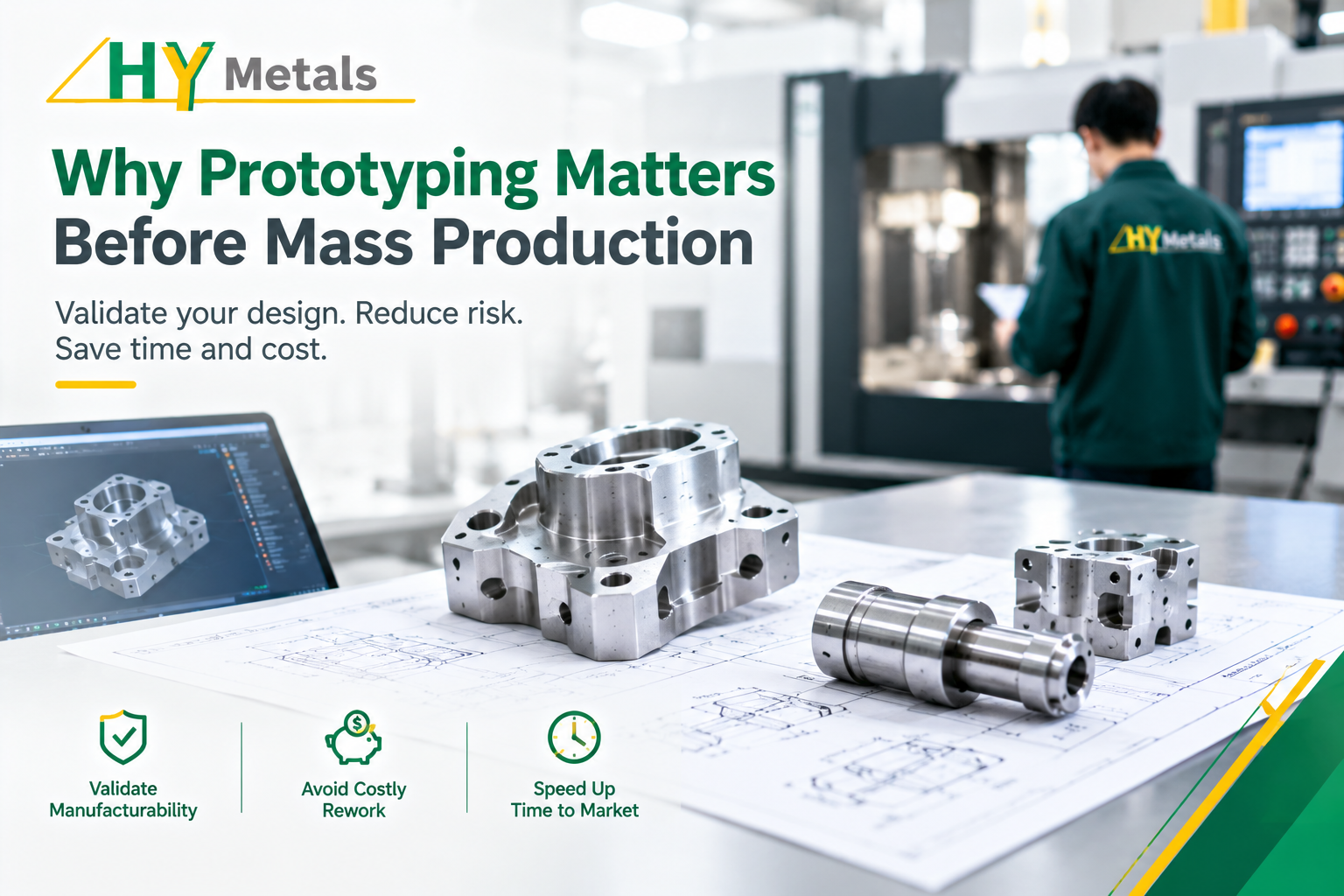
1. A Real Manufacturing Challenge: When Mass Production Starts Too Early
Consider a recent project involving 10,000 CNC turned parts. The customer required a hardness of 46–49 HRC after heat treatment, together with zinc flake coating for corrosion protection.
The customer wanted to move directly into batch production without first completing a comprehensive prototype validation process. During manufacturing, several problems emerged.
First, the heat treatment sequence caused hardness consistency problems. The initial process involved heat treating the material before machining. During production, the team found that the finished parts did not achieve consistent hardness as required. The process needed to be reviewed and changed to machining first, followed by heat treatment.
Second, the surface coating did not meet every performance expectation. Although the zinc flake coating offered good corrosion resistance, the customer discovered that its wear resistance was insufficient for the intended application. This required further evaluation and a change in the surface treatment solution.
Third, dimensional tolerances needed to be reconsidered. As the project progressed, the customer identified concerns with the dimensional requirements, leading to additional adjustments to the specifications and manufacturing process.
Each change affected production planning and created further coordination work. Instead of following a stable manufacturing plan, the project became a continuous cycle of adjustments, verification, and rework planning.
The key lesson was not that the customer had selected an inherently unsuitable process from the beginning. Rather, several important requirements had not been fully validated before committing to mass production.
A prototype stage could have helped identify these issues earlier, allowing the customer and manufacturer to agree on a more reliable production solution before manufacturing thousands of parts.
2. What Should Be Validated During CNC Prototype Testing?
A successful prototype project should evaluate more than the appearance and basic dimensions of a part. For components involving multiple manufacturing processes, several factors need to be considered together.
Machining Process and Sequence
The order of machining, heat treatment, and finishing can significantly influence the final result.
For hardened components, machining before or after heat treatment can affect tool wear, dimensional stability, and the ability to achieve the required geometry. The appropriate sequence depends on the material, part design, hardness requirements, and manufacturing method.
Prototype trials help manufacturers compare practical process options and identify potential risks before production quantities increase.
Material Properties and Hardness
When a component requires a specific hardness range, the requirement should be validated on representative parts.
Testing should consider the material grade, heat treatment process, hardness distribution, and measurement method. Where necessary, the team should also assess dimensional changes caused by heat treatment.
These checks help establish whether the proposed process can consistently meet the engineering requirements.
Surface Treatment Performance
A surface treatment must be selected according to the actual application, not just one performance characteristic.
For example, zinc flake coating is often selected for corrosion protection. However, corrosion resistance and wear resistance are different properties. A coating that performs well in a corrosion test may not provide sufficient resistance to friction or repeated contact.
Prototype testing can help determine whether the selected coating meets the required combination of corrosion resistance, wear performance, appearance, and dimensional constraints.
Dimensional Tolerances and Assembly
Prototype parts also allow customers to verify whether specified tolerances are necessary and achievable.
Measurements should focus on critical dimensions, mating features, and functional requirements. If parts are assembled with other components, testing the actual fit can reveal problems that may not be obvious from an isolated drawing review.
Confirming these requirements before mass production reduces the risk of discovering costly dimensional issues after a large batch has been manufactured.
3. Why Prototype Validation Reduces Total Cost
Prototype machining adds an initial step, but it can reduce the total cost of a project.
When a problem is discovered during prototyping, only a small number of parts may need to be modified or remade. When the same problem appears after thousands of components have entered production, the consequences can be much more significant.
Potential costs include:
- Repeated process adjustments and engineering reviews
- Additional inspection and validation
- Scrap or rework
- Delayed delivery
- Changes to tooling, fixtures, or production planning
- Additional testing of revised materials or coatings
Not every problem can be eliminated during prototyping. However, a structured validation process gives the customer and supplier an opportunity to identify important risks before committing to full-scale production.
The objective is not to make prototypes unnecessarily complicated. It is to test the features and processes that matter most to the product’s performance and manufacturing stability.
4. How HY Metals Helps Customers Move from Prototype to Production
At HY Metals, we specialize in custom manufacturing based on customer drawings, including CNC turning, CNC milling, precision machined parts, sheet metal fabrication, and related finishing processes.
Our role can extend beyond manufacturing parts to drawing requirements. Depending on the project, we can help review manufacturability, identify potential process risks, discuss material and finishing options, and evaluate practical production methods.
For projects involving heat treatment, tight tolerances, or specialized coatings, we encourage customers to clarify the complete technical requirements before mass production begins.
A practical workflow may include:
- Reviewing drawings, materials, tolerances, and functional requirements.
- Manufacturing prototype parts using a proposed process.
- Inspecting critical dimensions and verifying relevant material or hardness requirements.
- Evaluating surface treatment and application-specific performance.
- Reviewing test results with the customer and resolving identified issues.
- Confirming the final specifications and production process.
- Moving into mass production with a more thoroughly validated manufacturing plan.
The exact validation plan should reflect the component’s risks and intended application. Where functional performance cannot be confirmed through dimensional inspection alone, appropriate application-specific testing may also be necessary.
By involving manufacturing engineers early, customers can make informed decisions before production quantities increase.
5. Prototype First, Produce with Confidence
For custom mechanical parts, the fastest route to market is not always the route that starts mass production first.
A prototype provides an opportunity to verify the design, manufacturing sequence, material condition, surface treatment, and dimensional requirements under practical conditions. It also gives customers and suppliers a chance to resolve differences between drawing specifications and real-world performance.
This is particularly important for products that combine CNC machining, heat treatment, and surface finishing, where a change in one process may affect the others.
At HY Metals, we believe that good manufacturing starts with good preparation. Our prototype machining experience helps customers evaluate manufacturing solutions, identify potential issues, and prepare for a more stable transition to production.
Before committing to thousands of custom parts, validate the critical requirements with prototypes. A small investment in testing can help prevent much larger costs and delays later.
Planning a new CNC machining project? Contact HY Metals to discuss your drawings, prototype requirements, and path from initial samples to mass production.
Post time: Oct-29-2026