


Introduction
CNC machining is widely used to manufacture precision components for automation equipment, electronics, medical devices, aerospace applications, and industrial machinery. However, not all CNC machines offer the same capabilities.
One of the most important decisions when selecting a machining process is whether a part can be manufactured efficiently on a 3-axis machine or whether 4-axis or 5-axis machining is more appropriate.
The difference is not simply the number of axes. Machine configuration affects tool access, the number of setups, achievable geometry, production time, and overall cost.
Understanding these differences helps engineers design more manufacturable parts and helps purchasing teams select the right manufacturing partner.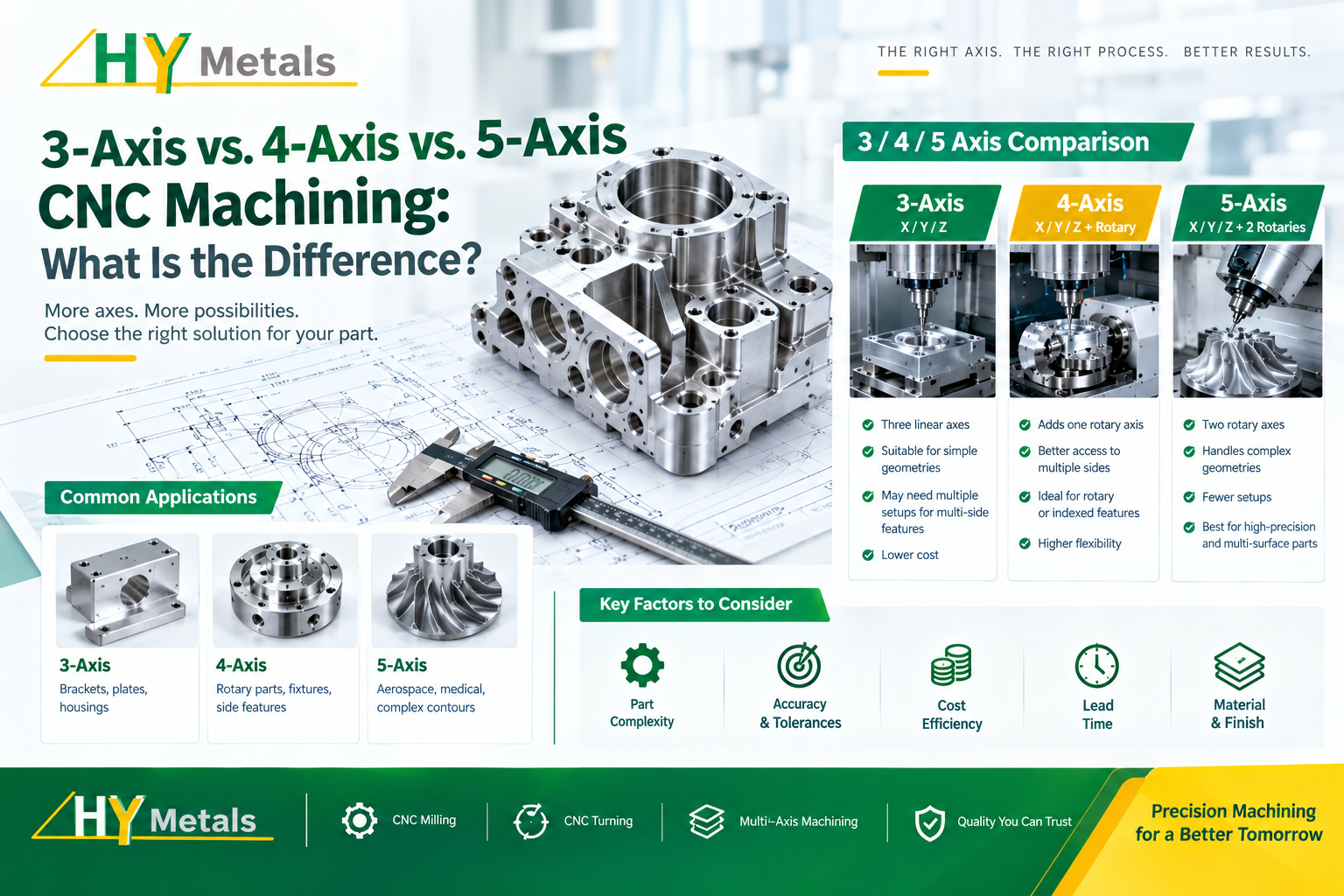
1. What Do the Axes of a CNC Machine Mean?
The three basic linear axes are:
Additional rotational axes allow the workpiece or cutting tool to change orientation.
A 4-axis machine typically adds one rotational axis, while a 5-axis machine adds two rotational axes. The exact configuration depends on the machine design: some rotate the workpiece, while others tilt or rotate the cutting head.
These additional movements allow a cutting tool to approach a part from more directions without manually repositioning the workpiece.
2. What Is 3-Axis CNC Machining?
A 3-axis CNC machine moves the cutting tool along the X, Y, and Z directions. The tool usually approaches the workpiece from one primary direction during a setup.
This configuration is suitable for many prismatic components, including mounting plates, brackets, spacers, blocks, and housings with features that can be accessed from the top or from different sides through additional setups.
Advantages of 3-axis machining
- Lower machine-hour cost in many applications.
- Broad availability and efficient production for simpler geometries.
- Straightforward programming for many conventional milling operations.
- Good suitability for flat surfaces, pockets, holes, and slots.
Limitations
- Features on multiple sides may require the operator to reposition the workpiece.
- Each additional setup can introduce alignment variation, increase labor, and extend production time.
3. What Is 4-Axis CNC Machining?
A 4-axis CNC machine adds a rotational axis to the three linear axes. In many configurations, the workpiece rotates around one axis so that machining can be performed on multiple sides.
This is particularly useful for components with repeated features around a central axis, side holes, or features distributed across several faces.
Typical applications include rotary components, housings with side features, fixtures, and parts that need machining at several angular positions.
Advantages of 4-axis machining
- Access to more sides of a part in a single setup.
- Reduced manual repositioning for suitable geometries.
- Improved consistency between features located at different angular positions.
- Potential reductions in handling time and total machining time.
A 4-axis machine is not automatically the best choice for every multi-sided part. The benefit depends on feature orientation, workholding, tool access, and whether the geometry requires simultaneous movement or simply indexed positioning.
4. What Is 5-Axis CNC Machining?
A 5-axis CNC machine combines three linear axes with two rotational axes. Depending on the machine and program, the tool and workpiece can be repositioned or moved simultaneously to machine complex surfaces and features from different orientations.
Five-axis machining is valuable for parts with angled surfaces, compound angles, deep cavities, complex contours, and multiple precision features that must maintain a defined relationship to one another.
Advantages of 5-axis machining
However, 5-axis machining generally involves more demanding programming, specialized equipment, and careful process planning. It may cost more than 3-axis machining for a simple part that does not benefit from the extra capability.
5. Key Differences at a Glance
| Factor | 3-Axis | 4-Axis | 5-Axis |
|---|---|---|---|
| Movement | Three linear axes | Three linear + one rotary | Three linear + two rotary |
| Part complexity | Low to moderate | Moderate | Moderate to very high |
| Multi-side machining | Often needs more setups | Improved access | Excellent access |
| Programming | Usually simpler | More involved | Often most complex |
| Initial machine cost | Generally lower | Generally higher | Generally highest |
| Best fit | Simple milled parts | Indexed/rotary features | Complex/multi-surface |
This comparison is general. Actual performance depends on machine design, tooling, workholding, tolerances, material, and production quantity.
6. Does 5-Axis Machining Always Provide Better Accuracy?
Not necessarily. A higher-axis machine does not automatically guarantee tighter tolerances.
Accuracy depends on machine condition and calibration, thermal stability, tool deflection, fixture rigidity, cutting parameters, material behavior, and inspection methods.
The major advantage of 4-axis and 5-axis machining is often the ability to manufacture multiple features with fewer setups. When important features are machined in one setup, their positional relationships may be easier to maintain because the workpiece is not repeatedly removed and re-aligned.
7. How Do Axis Configuration and Cost Relate?
The lowest machine-hour rate does not always result in the lowest total part cost.
When evaluating a quote, consider:
- Number of setups and fixture changes.
- Programming and preparation time.
- Cycle time and tool changes.
- Required tolerances and surface finish.
- Part quantity and repeatability.
- Inspection requirements and scrap risk.
8. How to Choose the Right CNC Machining Process
9. Why Engineering Review Matters
Before production, a capable CNC machining supplier should review the 3D model and engineering drawing, identify critical dimensions, assess tool access, and determine the most suitable workholding strategy.
At HY Metals, CNC milling and turning capabilities support custom precision components from prototypes to production.
Conclusion
The difference between 3-axis, 4-axis, and 5-axis CNC machining lies in more than machine movement. Each configuration offers a different balance of geometry capability, setup efficiency, programming complexity, and cost.
If you have a custom CNC machined part, share your drawing or 3D model with HY Metals. Our team can review the requirements and help you identify a practical, cost-effective manufacturing approach.
Post time: Oct-23-2026