


When ordering custom metal parts, one of the most important questions for engineers and purchasing teams is often: How tight does the tolerance really need to be?
Tolerance is a critical part of CNC machining because it directly affects part functionality, assembly, quality, production cost, and manufacturing lead time. However, tighter tolerance does not always mean better performance. In many applications, specifying unnecessarily tight tolerances can increase machining time and cost without providing any practical benefit.
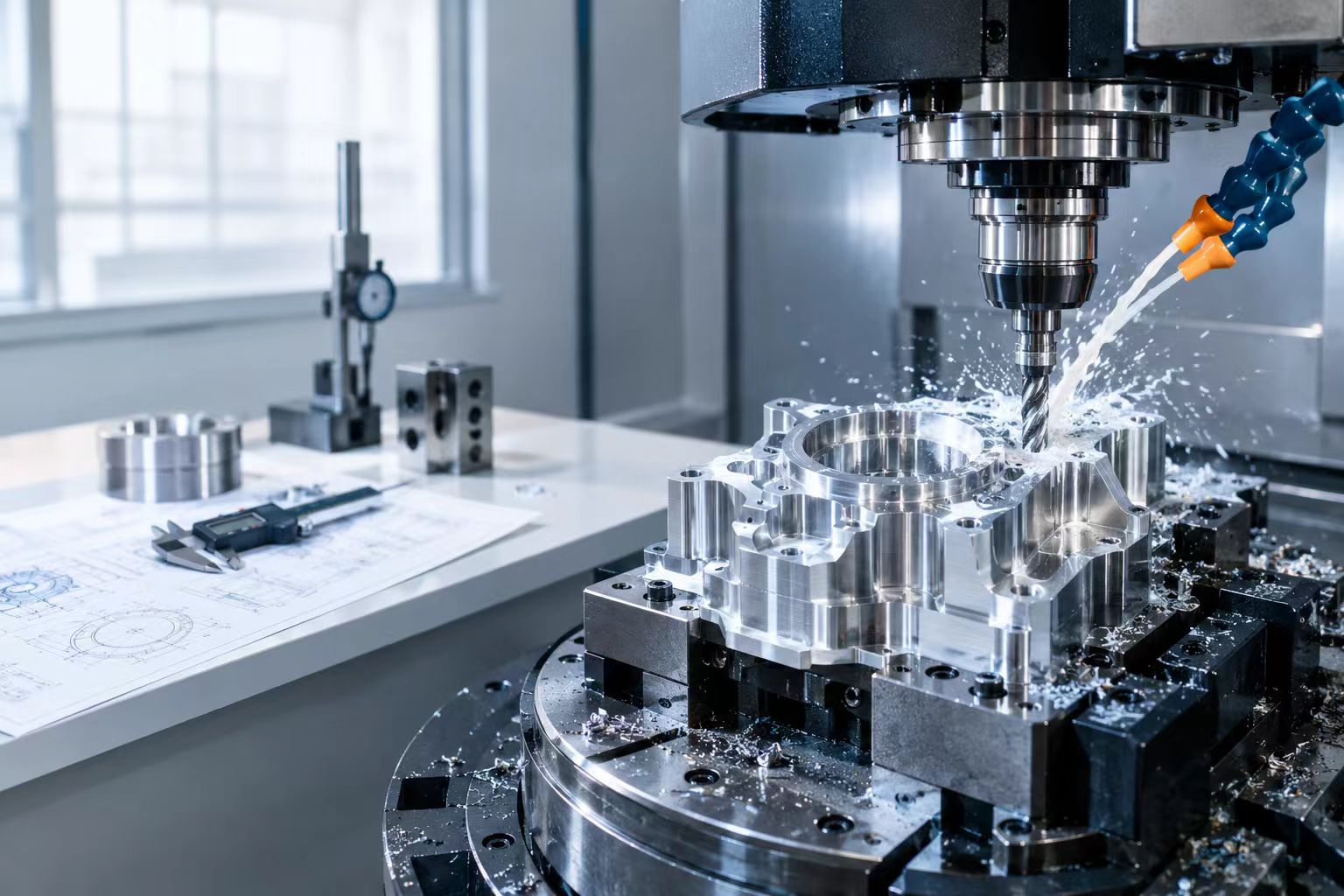
For companies sourcing CNC machined parts, precision machined parts, CNC turning parts, and custom metal components, understanding machining tolerances can make communication with a manufacturing partner much easier and more efficient.
With more than 16 years of experience in custom manufacturing, including CNC machining, CNC turning, and sheet metal fabrication, we have found that the best results come from balancing design requirements with realistic manufacturing capabilities.
What Is a CNC Machining Tolerance?
A machining tolerance is the acceptable variation from a specified dimension.
For example, if a drawing specifies a diameter of 20.00 mm with a tolerance of ±0.02 mm, the actual manufactured diameter should fall between 19.98 mm and 20.02 mm.
No manufacturing process can produce every part at exactly the theoretical dimension shown on a drawing. Cutting tools, machines, materials, temperature, measurement equipment, and production processes all introduce small variations.
Why Do CNC Machining Tolerances Matter?
Tolerance affects much more than dimensional accuracy.
What Factors Affect CNC Machining Tolerance?
- ✓ Machine Accuracy and Stability: The capability of the CNC machine is one of the basic factors. Calibration, rigidity, and thermal stability affect performance.
- ✓ Material: Different materials behave differently in terms of hardness, thermal expansion, and deformation.
- ✓ Part Geometry: Complex components with deep pockets, thin walls, or long internal features require more complicated processes.
- ✓ Tooling and Cutting Conditions: Tool selection, feed rate, and tool wear influence dimensional consistency.
CNC Turning vs. CNC Milling Tolerances
CNC turning is commonly used for cylindrical components such as shafts, pins, and bushings. CNC milling is better suited for components with flat surfaces, pockets, slots, and complex contours.
How Tight Should Your CNC Machining Tolerance Be?
A good rule is to specify the tolerance according to the functional requirement of the part. Ask yourself: Does this dimension affect assembly, sealing, bearing fit, or movement?
The Importance of GD&T in Precision Machining
Geometric Dimensioning and Tolerancing (GD&T) can be used to control characteristics such as Position, Flatness, Parallelism, Perpendicularity, Concentricity, Cylindricity, Profile, and Runout.
Tolerance Is Not the Only Measure of Quality
A reliable manufacturing partner should have a systematic approach to inspection, process control, material traceability, and equipment calibration.
What About Sheet Metal Parts?
Tolerance considerations are also important for sheet metal parts, although the manufacturing process is different from CNC machining.
Sheet metal fabrication can include laser cutting, bending, punching, riveting, tapping, welding, and other operations.
Compared with CNC machining, sheet metal components can be affected more significantly by material thickness, bending processes, springback, weld distortion, and part geometry.
For assemblies combining sheet metal fabrication and CNC machined parts, it is especially important to define critical interfaces clearly.
Post time: Sep-09-2026