


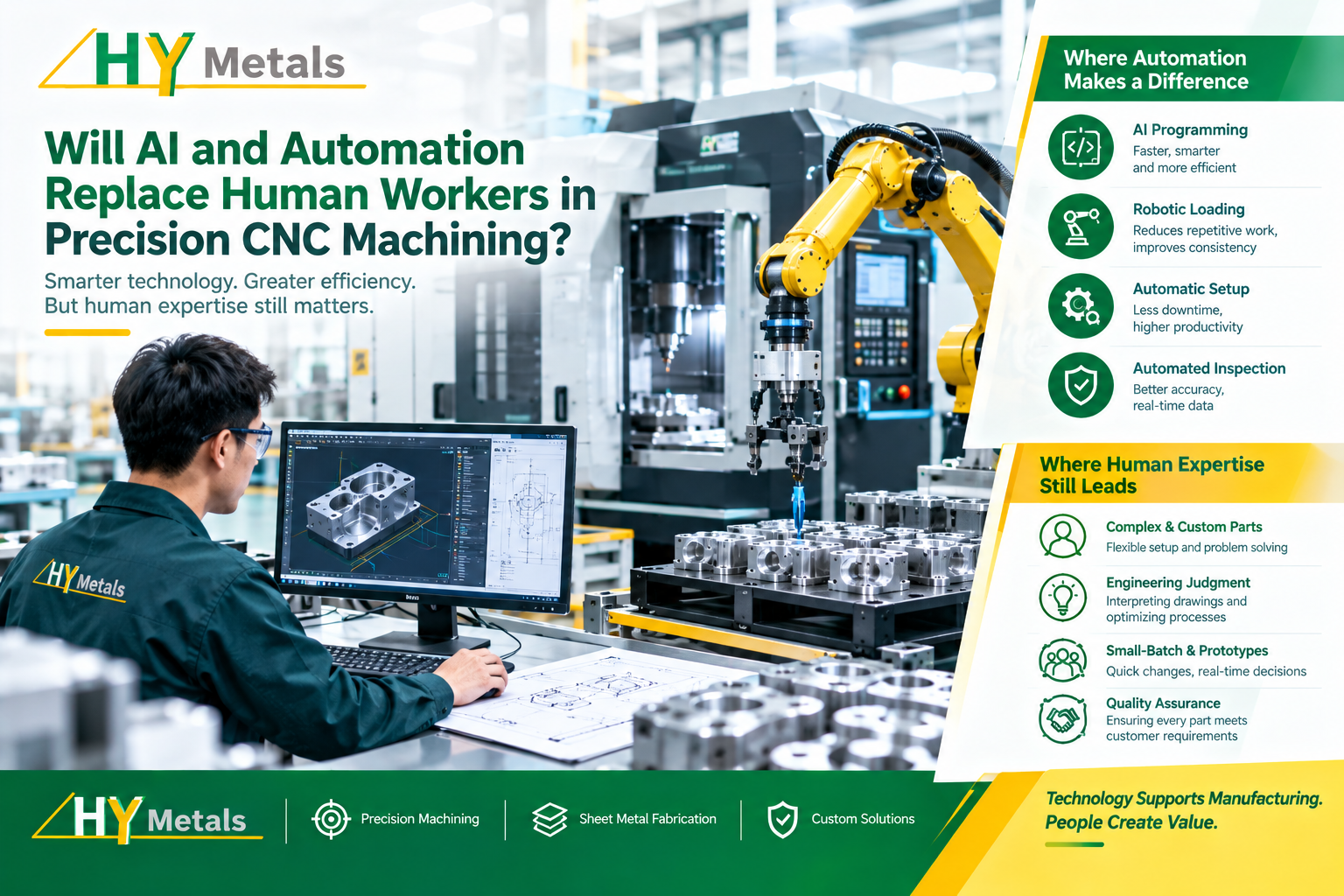
Artificial intelligence (AI) and automation are transforming the manufacturing industry. From automatic CNC programming and intelligent process planning to robotic loading systems and automated inspection, new technologies are making precision machining faster, more consistent, and more efficient.
This raises an important question for manufacturers and buyers alike: Will AI and automation eventually replace human workers in precision CNC machining?
The answer depends largely on the type of manufacturing involved.
For high-volume production with repetitive operations, automation can significantly reduce manual labor.
However, for custom CNC machining, prototypes, and small-batch production, replacing human expertise completely is much more difficult.
At HY Metals, where custom sheet metal fabrication and precision CNC machining are important parts of our business, we believe the future lies not in eliminating people from manufacturing, but in combining advanced automation with experienced engineers and skilled technicians.
1. AI Is Making CNC Programming More Automated
Traditional CNC programming requires knowledge of machining processes, cutting tools, workholding methods, cutting parameters, and machine capabilities. Experienced programmers must interpret engineering drawings and CAD models before developing suitable toolpaths and machining strategies.
AI-assisted manufacturing tools are beginning to automate parts of this process. Depending on the software and application, they can help with:
- Generating and optimizing CNC toolpaths
- Recommending cutting tools and machining parameters
- Identifying potential machining problems
- Improving material utilization and machining efficiency
- Supporting design for manufacturability (DFM) reviews
In the future, more programming tasks may be completed automatically, especially for common part geometries and well-established machining processes.
However, generating a toolpath is not the same as guaranteeing a successful machining operation.
A program must account for the actual machine, fixture, tool length, workpiece position, cutting forces, material behavior, and required tolerances. A toolpath that looks correct in software can still produce collisions, vibration, deformation, or dimensional errors if the real manufacturing conditions differ from the assumptions.
Human engineers will therefore continue to play an important role in reviewing programs, validating machining strategies, and solving problems that automated systems cannot reliably anticipate.
2. Automatic Setup and Robotic Loading Are Replacing Some Manual Tasks
Another major development is the use of automation for machine setup, workpiece handling, and production monitoring.
Robotic arms, automatic workpiece loading systems, pallet changers, and automated inspection equipment can reduce the need for operators to perform repetitive tasks.
For example, in a high-volume production environment, a CNC machine may manufacture hundreds or thousands of identical components. Once the process has been carefully developed and validated, a robot can load raw materials, remove finished parts, and repeat the cycle with minimal operator intervention.
This offers several advantages:
- Reduced repetitive manual work
- More consistent loading and unloading
- Improved machine utilization
- Potentially lower labor cost per part
- The ability to operate for longer periods with fewer interruptions
For manufacturers producing large quantities of standardized components, these technologies can deliver substantial productivity gains.
However, automation also requires investment in fixtures, sensors, safety systems, programming, integration, and maintenance. It is most effective when the production process is stable and the parts can be handled reliably.
The key factor is not simply whether a robot can load a machine, but whether automating the entire operation makes economic and technical sense.
3. Why Prototype and Small-Batch CNC Machining Are More Difficult to Automate
Prototype machining and small-batch custom manufacturing present a different set of challenges.
Unlike mass production, where the same part may run continuously for weeks or months, custom machining frequently involves changing designs, materials, dimensions, quantities, and delivery requirements.
A workshop may need to manufacture several different components in a single day.
Each new part can require a different combination of tools, fixtures, machining programs, workholding arrangements, and inspection methods.
- Consider the typical workflow for a custom CNC machined part:
- Review the customer’s drawings and 3D model.
- Evaluate the material, geometry, tolerances, and surface finish.
- Select the appropriate machine and cutting tools.
- Develop the CNC program and machining sequence.
- Prepare fixtures and establish workpiece coordinates.
- Run the first operation and inspect the result.
- Adjust machining parameters or compensate for errors when necessary.
- Complete the remaining operations and verify the finished part.
Some of these steps can be automated, but the entire workflow is not equally easy to standardize.
For a complex prototype, the first machining attempt may reveal unexpected deformation, difficult chip evacuation, tool-access limitations, or a tolerance problem. An experienced machinist or process engineer must assess the situation and determine the best corrective action.
The time spent changing setups and validating new processes can also reduce the economic benefits of a dedicated automation system.
For this reason, high-mix, low-volume manufacturing is generally more challenging to automate completely than stable, repetitive mass production.
This does not mean small-batch machining cannot benefit from automation. It means that flexible automation and human judgment are often more valuable than a fully dedicated production line.
4. Automatic Machine Setup Is Possible, but Not Always Practical
Automated setup technologies are advancing. Tool measurement systems, probing cycles, standardized fixtures, preset tools, and automatic workpiece alignment can reduce manual preparation time.
More advanced systems can also identify workpiece positions and compensate for certain variations automatically.
Nevertheless, custom parts often have unique features that require specialized workholding or an unconventional machining sequence.
Thin-walled aluminum components, for example, may deform under clamping pressure. Deep cavities may require special tools and careful toolpath planning. Parts with multiple precision surfaces may need to be repositioned several times while maintaining dimensional relationships.
An automated system can perform predefined setup procedures, but someone still needs to decide whether the selected setup is appropriate for the part.
As AI tools become more capable, they may assist with these decisions. Yet unusual geometries, conflicting tolerances, and unexpected machining behavior will continue to require engineering judgment.
The practical goal is to reduce setup time and make adjustments more reliable, rather than assume every custom component can be set up automatically without human involvement.
5. Precision Inspection Still Requires More Than Automation
Quality control is another area where automation is making significant progress.
Coordinate measuring machines (CMMs), vision measuring systems, probing systems, and automated measurement software can inspect dimensions with high repeatability. Inspection data can also help identify process trends and support automatic compensation.
These technologies are especially useful for critical dimensions and recurring production jobs.
However, measurement equipment cannot independently resolve every question about product quality.
Someone must determine which dimensions are functionally important, how the part should be positioned for measurement, which datum references apply, and whether the inspection results meet the engineering requirements.
For a new custom component, inspection may also reveal that the original design, manufacturing method, or tolerance scheme needs further discussion.
Experienced quality engineers and machinists connect measurement results with real manufacturing conditions. This ability to interpret data and make sound decisions remains important even when inspection itself is automated.
6. The Economics of Automation: Repetition Matters
Automation decisions should be based on total cost, production stability, and expected demand rather than technology alone.
A dedicated robotic loading system may be highly economical for a part produced in large quantities. The initial investment can be spread across many thousands of production cycles.
For a prototype requiring only five pieces, however, designing special fixtures, programming a robot, and validating the complete process may cost more than having a skilled operator perform the work manually.
The economics change when the same part becomes a repeat order. If demand increases and the design remains stable, a manufacturer may introduce standardized fixtures, reusable programs, automatic probing, or robotic loading.
This suggests a practical approach:
- One-off prototypes: Prioritize engineering flexibility, fast setup, and problem-solving.
- Small-batch production: Use automation selectively where it reduces recurring work without creating excessive setup costs.
- Repeated medium-volume production: Consider standardized fixtures, probing routines, and flexible automation.
- High-volume production: Evaluate more extensive automation when demand and process stability justify the investment.
The appropriate solution depends on the part, its production volume, quality requirements, and expected product life cycle.
7. The Future Is AI-Assisted, Human-Guided Manufacturing
AI and automation will undoubtedly change the skills required in precision machining.
Some repetitive programming, loading, measurement, and data-processing tasks may require less manual intervention. At the same time, manufacturers will need people who can operate advanced systems, evaluate automated results, manage exceptions, and improve manufacturing processes.
The value of a skilled machinist will increasingly come from understanding why a process works, not simply from performing a repeated operation.
An experienced engineer can recognize when a design is difficult to manufacture, identify a better machining sequence, balance tolerance requirements against cost, and make practical decisions when the actual process differs from the original plan.
AI can help analyze options and accelerate routine work. Automation can execute repeatable tasks. But the ability to combine engineering knowledge, production experience, and customer requirements remains essential.
The most competitive manufacturers will likely be those that adopt automation where it creates measurable value while continuing to invest in the people who make complex manufacturing decisions.
8. How HY Metals Approaches Custom Manufacturing
At HY Metals, we focus on custom manufacturing based on customer drawings, including precision CNC machined parts, CNC turning, sheet metal fabrication, and related finishing and assembly processes.
Many custom projects involve prototypes, small production batches, complex geometries, or frequent design changes. These projects require more than machine capacity alone.
They require careful drawing review, practical process planning, appropriate workholding, accurate machining, inspection, and communication between the customer and manufacturing team.
Automation can support this work by improving programming efficiency, reducing repetitive handling, and making inspection more consistent. At the same time, experienced engineers and technicians remain important for interpreting requirements, resolving manufacturing challenges, and adapting processes to different parts.
We believe the best manufacturing approach is not to automate everything regardless of cost or complexity. It is to identify where automation improves quality, efficiency, and consistency while preserving the flexibility needed for customized production.
For customers, this combination can mean more practical engineering support, better control of manufacturing risks, and a production process suited to the actual requirements of each project.
Conclusion
Will AI and automation replace human workers in precision CNC machining?
They will replace or reduce some repetitive tasks, particularly in stable, high-volume production. AI will also make programming, process planning, and inspection more efficient.
However, prototype machining and small-batch custom manufacturing involve frequent changes, specialized setups, engineering decisions, and unexpected technical challenges. These characteristics make complete automation more difficult and, in many cases, less economical.
The future of precision machining is therefore unlikely to be a simple choice between people and machines.
It will be a combination of intelligent software, flexible automation, advanced equipment, and experienced manufacturing professionals.
For custom CNC machining suppliers, the ability to combine technology with practical engineering expertise will remain a major source of value.
Looking for a manufacturing partner for prototypes or small-batch custom parts? Contact HY Metals to discuss your drawings, machining requirements, and manufacturing options.
inquiry@hymetalproducts.com
Post time: Oct-29-2026