


What Is CNC Machining? A Complete Guide for Buyers and Engineers
CNC machining is one of the most widely used manufacturing processes for producing accurate metal and plastic components. From simple brackets and shafts to complex aerospace components, electronic housings, heat sinks, and precision mechanical parts, CNC machining can produce a wide range of custom components with excellent repeatability and dimensional accuracy.
But what exactly is CNC machining, how does it work, and how should engineers and purchasing teams choose the right CNC machining process for their parts?
This guide explains the CNC machining process from a practical manufacturing perspective and covers CNC milling, CNC turning, multi-axis machining, materials, tolerances, surface finishes, quality control, and production applications.
For companies looking for custom CNC machining, CNC machined parts, precision machining, or CNC turning services, understanding the manufacturing process can also help you prepare better drawings, make better design decisions, and select the right manufacturing partner.
What Is CNC Machining?
CNC stands for Computer Numerical Control.
CNC machining is a subtractive manufacturing process in which computer-controlled machine tools remove material from a solid workpiece to create a finished component.
The process typically begins with a 3D CAD model or 2D engineering drawing. Manufacturing engineers then use CAM software to develop tool paths and machining strategies. The resulting CNC program controls the movement of the machine, including the cutting tool, spindle, workpiece, and other machine axes.
Unlike manual machining, CNC machining can automatically repeat the same programmed operations with a high degree of consistency.
Depending on the machine and component geometry, CNC machining can be used to create:
- Holes and bores
- Slots and pockets
- Threads
- Flat surfaces
- Curved surfaces
- Contoured profiles
- Precision shafts
- Complex mechanical components
- Thin-wall structures
- Multi-sided components
This makes CNC machining suitable for both prototypes and production parts.
How Does CNC Machining Work?
Although CNC machining may look highly automated from the outside, producing a good CNC machined part involves much more than simply loading a CAD file into a machine.
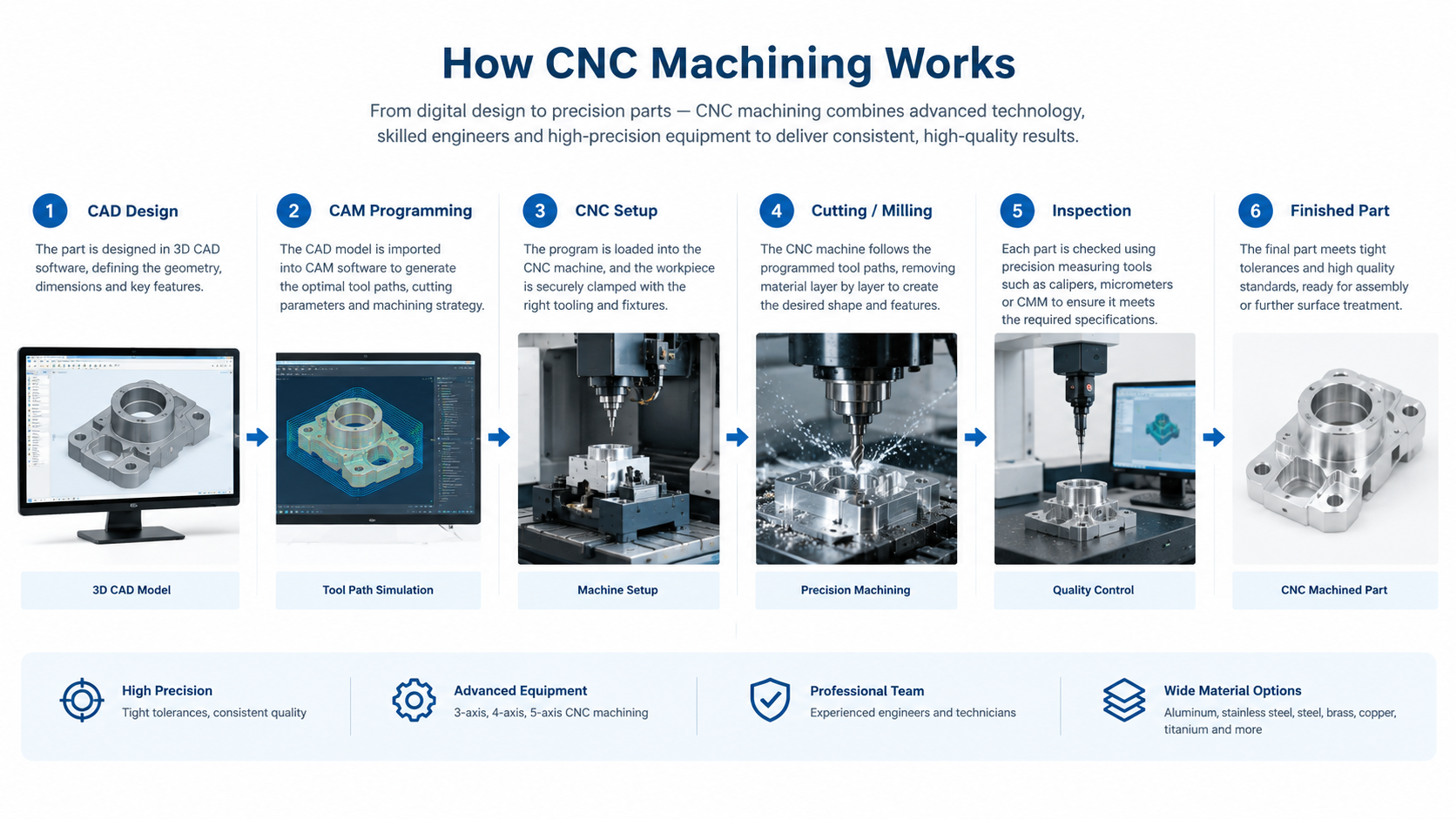
A typical process includes several important steps.
1. CAD Design
The process usually begins with a 2D drawing, 3D CAD model, or both. The design defines the geometry, dimensions, material, tolerances, surface finish, threads, holes, and other requirements of the part.
2. Manufacturing Engineering and CAM Programming
The CAD model is imported into CAM software. Manufacturing engineers determine how the part should be machined, including:
- Tool selection, Cutting strategy, Machining sequence
- Workholding method, Cutting parameters, Number of setups
- Tool paths, Inspection requirements
This stage is extremely important for complex CNC machined parts. Two manufacturers may use the same CNC machine but achieve different results because their tooling, fixtures, machining strategies, and process controls are different.
3. CNC Machine Setup
The workpiece is securely mounted on the CNC machine using appropriate fixtures, vises, chucks, or custom workholding. The tools are loaded and the machine is calibrated and referenced.
4. Material Removal
The CNC machine follows the programmed tool paths. Depending on the operation, cutting tools remove material through milling, drilling, boring, threading, turning, or other machining processes.
5. Inspection
After machining, the part is inspected against the engineering drawing using calipers, micrometers, height gauges, thread gauges, optical measurement, CMM inspection, or surface finish measurement.
Project Consultation
Have a CNC machining project? Send your drawings and requirements to HY Metals for a manufacturing review and quotation.
Post time: Sep-09-2026